
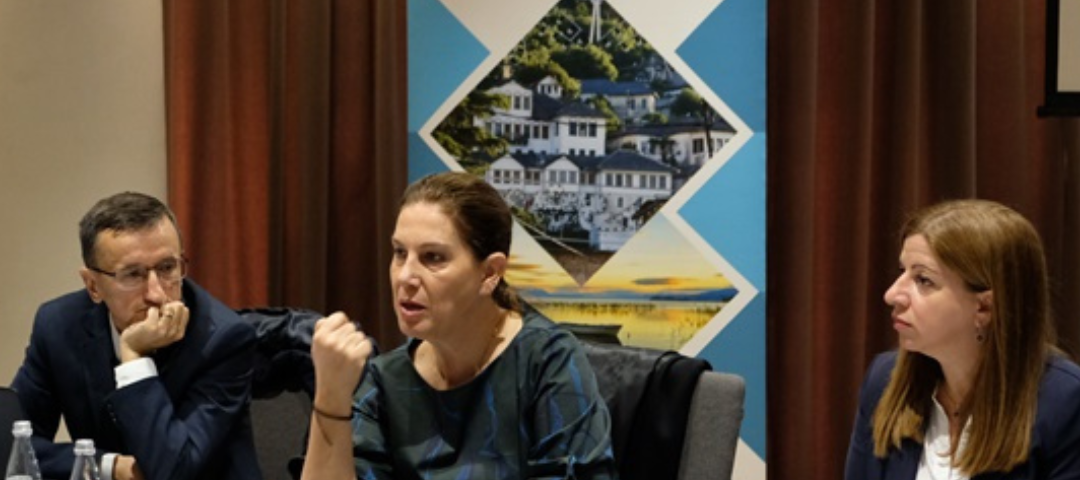
On 23 November 2021, in the presence of the Minister of Tourism and Culture, Ms. Mirela Kumbaro, and key stakeholders in the field of tourism, a national roundtable on DMOs in Albania was held.
The roundtable was organized by DMO-Albania within the framework of the project “Raising awareness and lobbying policymakers for the development model of DMOs in Albania”, supported by the IdeAL project of Co-Plan, the Institute for Habitat Development, funded by the EU.
DMO ALBANIA presented the project, where it focused during one year, presented the results of the roundtables with interest groups in three areas: Berat, Pogradec and Saranda, as well as the findings of a study prepared by tourism and law experts regarding the suggestion of a functional model for DMOs in Albania.
DMO ALBANIA requested that for sustainable management of destinations, a new legal framework is needed, in accordance with Objective 5 of the Sustainable Tourism Strategy 2019-2023.
Minister Kumbaro further stated that it is not necessary to immediately move to a new law, if we do not first have a discussion with interest groups in 12 regions of the country. All tourism stakeholders present, primarily donors: GIZ ALBANIA, RISI ALBANIA, as well as private initiatives: Visit GJirokastra, Visit Tirana, Visit Saranda, Visit Dibra, each expressed their own opinions regarding DMO.
What was expressed was the lack of cooperation at the local level for efficient management of the destination, as well as the overlapping of many similar projects.
At the end of this roundtable, we are listing some conclusions:
We are very happy that the national debate was finally opened with all stakeholders for a legal framework for ‘Destination Management Organizations’ (DMOs), based on the Sustainable Tourism Strategy 2019-2023, Objective 5 (Support for Destination Management 5.1;
Consolidation of the legal and institutional framework for the management and operation of DMOs) We fully agree with the suggestion of the Minister of Tourism and Environment, Ms. Mirela Kumbaro, to launch a consultation at the regional level, to discuss with all stakeholders to promote public-private-community partnerships (P-P-C), to exhaust the mechanisms within the current laws to manage destinations and to further explore the possibilities for legal intervention or a new law.
We believe that there is more value in consulting at the regional level, as OMDs should be seen as ‘regional’ and not at the level of small municipalities, as they generate more tourism and income and keep tourists in the destination longer through more complete and diverse tourist packages.
We are very enthusiastic about the open and constructive debate of all stakeholders: the Ministry of Tourism and Environment, subordinate institutions of AKT, AKB, local stakeholders, civil society and donors, etc., which resulted in a synchronized opinion that destinations should be managed and branded locally, as locals know the potential, needs and problems well and can better adapt to future crises.
We also agree that effective and long-term management of a destination is achieved if all local stakeholders, including the Municipality, Prefecture, other cultural and environmental institutions, tour operators, hotels, restaurants, and other tourism businesses, civil society and even the community, sit together continuously, whenever necessary, at a table. This should be an ongoing process, with sustainable local stakeholders and not stop depending on political changes every 4 years.
The debate regarding the survival of the current DMOs is not only about financial support, as there are donors who are still supporting them at the moment.
The debate essentially concerns: the full involvement of local tourism stakeholders in decision-making for tourism in the destination, in assuming an important role for these organizations, in co-drafting the destination’s tourism strategy, in collecting and analyzing tourism statistics, in creating tourism products including all tourism businesses, including in rural areas, in co-drafting the event calendar, in the promotion calendar, which areas need tourists (distribution of tourists and income), in organizing events, fairs, but also in managing in the event of a crisis such as the pandemic to find possible ways to continue tourism, find new markets, or support local businesses, in training, employment, etc.
In order for a destination to be managed well and not in a chaotic manner, these issues must be discussed and placed in a special, stable, all-inclusive structure, that is, in a grouping of all stakeholders. Regarding public-private partnerships in each destination, there are several questions that require answers: What criteria should these partnerships, organizations have to be recognized by the Municipality, or District Municipalities, and accepted as important actors for management